
How to Measure Glasses Size
Learning how to measure glasses size is easier when you start with a pair you already wear comfortably. The most important measurement is the total frame width. Measure straight across the front of your current glasses, then compare the result with the Frame Width listed on the product page.
Quick answer: Measure the full width of your glasses from the outer edge near one hinge to the outer edge near the other hinge. Use the numbers printed inside the temple arm—such as 52–18–145—as a second check, not as a replacement for total frame width.
1. Measure the Total Frame Width First
At Olet Optical, Small, Medium, Large, and Oversized frame categories are based primarily on the total width across the front of the frame. Frame width is usually not printed inside your glasses, so you will need to measure it manually.
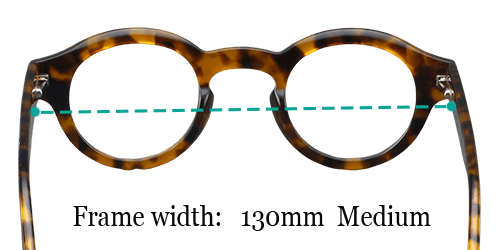
How to measure frame width
- Choose a pair of glasses that currently feels comfortable.
- Place the glasses on a flat surface with the front of the frame facing upward.
- Use a ruler marked in millimeters.
- Measure straight across the front from the outer edge near one hinge to the outer edge near the other hinge.
- Do not include the temple arms in the measurement.
- Record the width in millimeters and compare it with the Frame Width shown on the product page.
Keep the ruler straight rather than following the curve of the frame. For strongly curved or wraparound styles, use the straight horizontal distance across the front.
Olet Optical frame width size ranges
| Frame Size | Total Frame Width |
|---|---|
| Small | 110–125 mm |
| Medium | 126–135 mm |
| Large | 136–145 mm |
| Oversized | 146 mm and above |
If your comfortable frame measures between 110 and 125 mm wide, you can start by browsing our Small Glasses collection.
Important: Size labels can vary between eyewear retailers. When comparing frames on Olet Optical, use the exact Frame Width in millimeters rather than relying only on a Small, Medium, or Large label.
2. Read the Numbers Printed Inside Your Glasses
Most glasses have three numbers printed inside one of the temple arms. They may also appear on the bridge or on a demo lens. A common example is 52 □ 18 145 or 52–18–145.
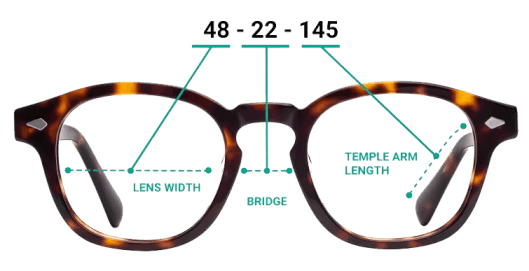
52 mm — Lens width: The horizontal width of one lens at its widest point.
18 mm — Bridge width: The distance between the two lenses across the bridge area.
145 mm — Temple length: The length of the temple arm from the hinge to the end of the tip.
These printed numbers do not normally show the total frame width. Use them as a second check after comparing the Frame Width.
Two frames with the same 52–18–145 measurements can still have different overall widths. Rim thickness, hinge construction, lens shape, and decorative details can all affect the total width of the frame.
3. Check the Bridge and Nose Fit
Bridge width affects how the frame rests on your nose. A suitable bridge should feel stable without creating excessive pressure or allowing the glasses to slide down repeatedly.
- If the frame frequently slides down, the bridge may be too wide or its shape may not match your nose.
- If you feel noticeable pressure on the sides of your nose, the bridge may be too narrow.
- Frames with adjustable nose pads allow the position and angle of the frame to be fine-tuned more easily.
Acetate frames normally have a fixed molded bridge, so it is especially useful to choose a bridge width and shape similar to a pair that already fits you well. Adjustable nose pads can improve the fit, but they cannot fully compensate for a frame that is substantially too wide or too narrow.
4. Compare Lens Width and Temple Length
Lens width
Lens width describes one lens, not the entire pair of glasses. It is useful when comparing frames with a similar shape and construction, but it should not be used alone to determine overall frame size.
Temple length
Temple length affects how the arms extend over and behind your ears. Temple arms that are too short may pull the frame backward or feel tight. Arms that are much too long may not sit securely behind the ears. Comparing the temple length with a comfortable pair is usually the simplest approach.
5. Avoid These Common Measuring Mistakes
- Measuring only between the inside edges: Measure the complete front width from outer edge to outer edge near the hinges.
- Confusing lens width with frame width: A printed number such as 52 mm normally refers to one lens.
- Following the curve of the frame: Measure a straight horizontal line across the front.
- Comparing size labels from different stores: Retailers may define Small, Medium, and Large differently, so compare the actual millimeter measurements.
6. What If You Do Not Have a Comfortable Pair to Measure?
You can use the closest-fitting pair available, including prescription sunglasses or non-prescription glasses. Begin with the listed Frame Width, then compare the bridge design, lens width, and temple length.
Keep in mind that frames with the same width can feel different because of their shape, material, rim thickness, nose construction, and temple design. Measuring a comfortable pair is a reliable starting point, but no single measurement can guarantee exactly the same fit across every frame style.
Best tip: Start with total Frame Width, then use the printed lens width, bridge width, and temple length as supporting measurements.